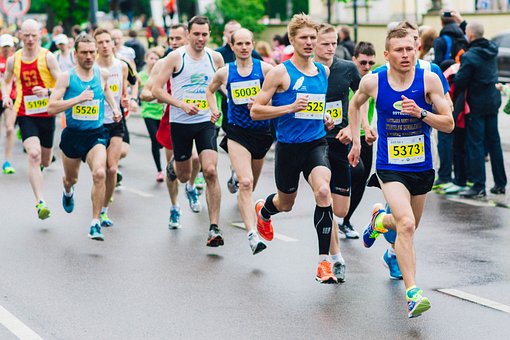
Not long ago, a runner planning to race 50 miles in one go would have been branded a maniac. But today more and more runners are leaping ultra running. Having run all kinds of events, including ultras, I can see why. The wild courses can make road races look bland. There’s the fun of running for the unadulterated enjoyment – up to marathon distance the focus is often on your time, but that yardstick becomes irrelevant on hugely varying ultra courses, and the experience becomes the priority. Then there’s the mental challenge – modern life offers few opportunities to push ourselves to our physical and mental limits. Ultra running is all about that journey. An ultra is certainly a serious undertaking, but it’s achievable if you follow some clear guidelines, and have a solid training plan and plenty of determination. Here is the essential information you’ll need to train for and tackle an ultra. But be warned: this is an addictive pastime.
A 50-miler will earn you your ultra badge of honor – it’s a challenge, for sure, but not so far as to be so intimidating you daren’t even try it. This 16-week schedule, designed by endurance coaches Neil Scholes and George Anderson, is designed to fit around work and busy lives. To take it on, you need to be fit enough to be able to run for two hours without stopping. Previous marathon experience is valuable, to give you an idea of the kind of fatigue you’ll need to be prepared for in training and the event.
‘The fact ultras are tough should motivate your desire to train,’ explains Scholes. ‘No one bets they’ll finish a 50-miler – there’s too much that can go wrong. So coming up short on your preparation isn’t an option. To make sure yours goes to plan, Scholes advises smart scheduling and flexibility. ‘Moving sessions is fine; it’s only when you regularly start missing them that it becomes an issue.’
Time your sessions to replicate race conditions, says Anderson. ‘In any 50-miler you’ll need to push through exhaustion, but running 50 miles in training to simulate running tired takes more time than most of us have. You can get the experience by getting up three hours earlier than usual and running longer sessions then.’
And don’t neglect recovery. ‘Running doesn’t make you fitter, recovery does.’
On race day, the pace is everything and with an ultra, this means starting slowly.
‘Those first 10-15 miles will feel ridiculously easy,’ says Anderson, ‘but resist temptation. Anyone can be a hero at the start of an ultra, it’s being a hero at the end that matters.’ Here’s an extreme example: one year I started the Ultra Trail du Mont Blanc in the last position and built up gradually, making up over a thousand places to sneak into the top half of the finishers. To be overtaken rather than being overtaken at the end of a race is a massive mental boost.
And don’t be afraid to have walk breaks. Marching uphill uses less energy than running, is only a little slower, and saves your energy for the flats and descents.
Focus on your form, strength, and stretching to ensure minor issues don’t become big problems.
Guide to Ultra-Marathon Training
Increase Your Cadence
This is the number of times your feet hit the ground in a minute. A quicker cadence lightens your footfall and reduces ground contact time, which helps lower injury risk. ‘Don’t worry too much about a number, just try to gently increase your cadence until things feel lighter underfoot,’ advises form expert James Dunne. Most runners find success in the 165-185 stride-per-minute range.
Avoid overstriding
‘When you land your foot too far ahead of you, it’s like putting the brakes on, and you overload your ankles, knees, hips, and lower back,’ says Dunne. ‘Runners should aim to land each step beneath the knee.’
Smooth and light
‘Being smooth and light is more important than style,’ explains Dunne. ‘Just be careful not to go so far with an increasing cadence that you end up running right on your toes – if there’s no time to allow heel contact you’ll overload the calves and Achilles tendon.’
Stretch your hips
Tight hips are a common problem in people who sit at a desk all day. ‘Sitting for long periods tightens the front of the hip, inhibiting the glutes and lengthening the hamstrings so you don’t get enough propulsion,’ says Dunne. ‘The body then generates this from the calf and Achilles instead, and injury comes next. For ultras, hip mobility is vital. To loosen your hips, do this stretch regularly: kneeling on one knee and keeping your body upright, lean forward while tensing the glute and quad in the kneeling leg. Do this until you feel a pull around the hip flexor, and hold for 20 seconds. Relax and swap legs. Repeat on both sides, but this time squeezes your glute for a second when you find the stretch point: do this 20 times.
Know your pain
Learn the difference between good and bad pain. You feel good pain evenly all over, like a warm general soreness – this is the sign of hard work well done. Bad pain is focused in one place, doesn’t go away, worsens with ongoing training, and needs immediate attention.
To hold form you need strength in your glutes, lower back, and hamstrings. Target them with these exercises.
Squats
With your feet shoulder-width apart, lower down and push your bum back. Make sure your knees don’t move in front of your toes. Pause when your thighs are parallel to the ground, then squeeze your glutes to push back to the start position. 3×15 reps
Glute bridges
Lie on your back with your arms by your sides and your knees bent. Squeeze your glutes and slowly lift your bum until your body forms a straight line from your shoulders to your knees. Hold this position for a couple of seconds, then slowly lower yourself back to the ground. 3×15 reps
Swiss ball hamstring curls
Lie on your back with your arms at your sides and your heels resting on top of a Swiss ball. Raise your hips so your body forms a straight line, then engage your hamstrings to bend your knees and pull the ball towards your bum. Return to the starting position. 3×10 reps
Is a “Couch to 50K” Actually Possible?
One hundred percent YES! I believe that you can finish a 50k with no baseline fitness to speak of. That said, there’s always the possibility that things could go wrong during training and derail your race plans, but really, that could happen to anyone.
I would say, however, that if you are opting for the eight-week program, you are running a higher risk of injury by compressing your training and leaving yourself less wiggle room to adjust your timeline in response to your body’s needs and overall fatigue.
With running, the worst thing that can happen is that you develop an injury that prevents you from completing your goal. I’ve had to pull out from my fair share of races and sometimes you can do everything right and still get an injury. What we’ll aim to do is structure the training plan to give you your best shot at success.
One thing you have going for you is that, in my opinion, a couch-to-trail 50k is actually in some ways easier on your body than a couch-to-road marathon program. At this point, you probably know that 50k is roughly 31 miles—about five miles longer than a marathon.
The key difference, however, is that the vast majority of 50k races take place on trails. And from an injury perspective, trials are your friend. Why? Because they’re soft and your body suffers far less pounding and trauma than it does on the roads.
On trails, you’ll be adjusting your speed to the terrain, hiking a lot of the uphills, you’ll be stepping over fallen trees, and rock-hopping over creek beds, all of which trigger and stress different muscles in your lower body. It’s the repetitive metronomic nature of road running that leads to the majority of injuries.
The long run and easy runs
Fundamentally, the goal is to slowly build your volume (amount of running per week) over time so that you build fitness and prepare your body to cope with 31 miles of running, but not build volume so quickly that you get injured. Our bodies get stronger through phases of stress and recovery.
You break down your muscles and place stress on your cardiovascular system so that afterward, with proper fueling and recovery, they rebuild and strengthen so that they can handle more work than they previously could.
I will be prescribed 3-5 days of running per week with one long run day and one interval workout day per week. Your other days will be shorter easy runs where you’ll be developing efficiency and actively recovering from your long run or intervals.
The “long run” is pretty self-explanatory; it’s one run per week where you push your endurance system and train your body to go for a long time. We start conservatively and bump up the long run mileage a few miles per week.
Easy days are just as they sound. Pick a trail, run from home, grab a friend to join you, whatever works; the goal is to just get the run in and not worry about pace or effort. Your body is absorbing your training during these runs and doesn’t need any more stress than you’ve already placed on it. Go EASY.
My only other advice would be to make sure some of your runs are on terrain that is similar to what you’ll find on race day. If there will be lots of short steep climbs on the 50k course, make sure to integrate those types of climbs into your training. You shouldn’t be tackling anything on race day that you haven’t already done in training, except for actually covering the full 31 miles.
Cross-Training For Ultra Runners
In the training plan below, I ask you to complete one day per week of cross-training. Shoot for 30-60 minutes. What is cross-training? Well, I want you to view it as anything that gets the blood pumping and that you enjoy doing. Don’t do anything that’s emotionally taxing or stressful.
This should be an activity that allows you to move but still recharges the battery. Some examples are yoga class, rock climbing, neighborhood bike cruise, chopping wood, dancing all-out to Michael Jackson’s Thriller on repeat, swimming across a lake, or shadowboxing against your boss.
If you can hold a beer and not spill while doing it, I’m going to say it doesn’t count as cross-training. So no horseshoes, bocce balls, or floating the river.
This is your opportunity to flush out the legs, burn a few calories, use some muscles that you don’t use while running, and help build your supportive body structure so that you can continue to run healthy.
Injury Prevention, Rest, and Recovery
One of the primary requirements of a successful and enduring foray into ultra running is that you always need to be listening to your body. Don’t get too caught up in mileage and numbers or subjective metrics for what may or may not get you to the finish line. The ultimate goal of any long-distance training program is not actually to get you to the finish line, the real goal is to get you to the starting line!
The race itself will be hard and you can challenge yourself and push as hard as you can on that day, but if you’re not healthy, you won’t even be at the race. If following this principle means you don’t hit your weekly targets, that’s okay! Do what you can, don’t be too stubborn; make sure you listen to your body and make it to the starting line to give yourself a fighting chance.
Beyond listening to your body and adjusting your training to prevent injuries, you’ll also want to set yourself up for success with good recovery habits. First off, sleep is HUGE. Get as much of it as you can.